Belinda Durrant
  • About Me
  • Exhibitions & Events
    • Artist in Residence Berkeley Castle 2017
    • Stour Gallery Exhibition
    • Residency at Sudeley Castle
  • Galleries
    • Art Dolls
    • Mrs Beeton
    • Lead Sculpture
    • Paper Sculpture
    • Needlework
    • Drawings
  • Blog
  • Press & Media
  • Contact
  • About Me
  • Exhibitions & Events
    • Artist in Residence Berkeley Castle 2017
    • Stour Gallery Exhibition
    • Residency at Sudeley Castle
  • Galleries
    • Art Dolls
    • Mrs Beeton
    • Lead Sculpture
    • Paper Sculpture
    • Needlework
    • Drawings
  • Blog
  • Press & Media
  • Contact

Blackwork Drawings

2/12/2016

 
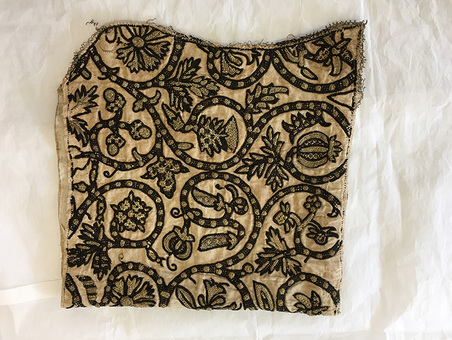
When we use the term ‘blackwork’ it is usually assumed that we are referring to a particular style of needlework that was at its most popular in the sixteenth and early seventeenth centuries in England.

It became very fashionable during the reign of Henry VIII. At the time it was referred to as ‘Spanish work’ possibly because Henry’s first wife Catherine of Aragon is known to have brought garments decorated with blackwork with her from Spain. Although its popularity is attributed to Catherine of Aragon, it was known in England before 1500.
Picture
Blackwork Coif 1580-1600, Fashion Museum, Bath
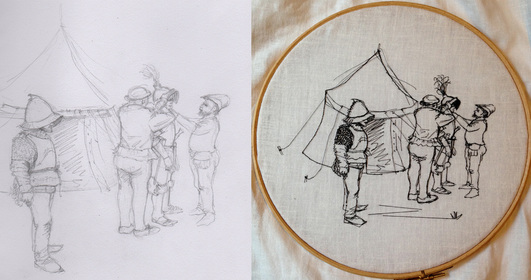
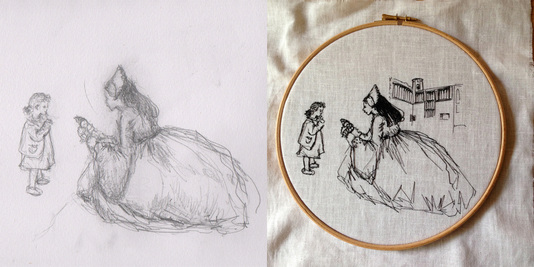
​However, technically blackwork is any embroidery executed in a black thread on a white ground fabric so I have appropriated the term to describe a series of stitch work in which I have re-interpreted some of the pencil sketches I made at Sudeley Castle.
 
I wanted to keep the informality of the sketches so have used black thread as a mark maker or drawing tool, rather than trying to interpret the drawings using formal embroidery stitches.
 
Each drawing was transferred very faintly to the linen using tracing paper, and the stitched  ‘drawing’ was done with constant reference to the original pencil drawing.
 
Here are a couple of examples.
Picture
Putting on Armour
Picture
​The Tiara

Comments are closed.
© COPYRIGHT 2019. ALL RIGHTS RESERVED.